How to look closely at a painting when you know little about art
· Editorial team newswithtomseattle.com
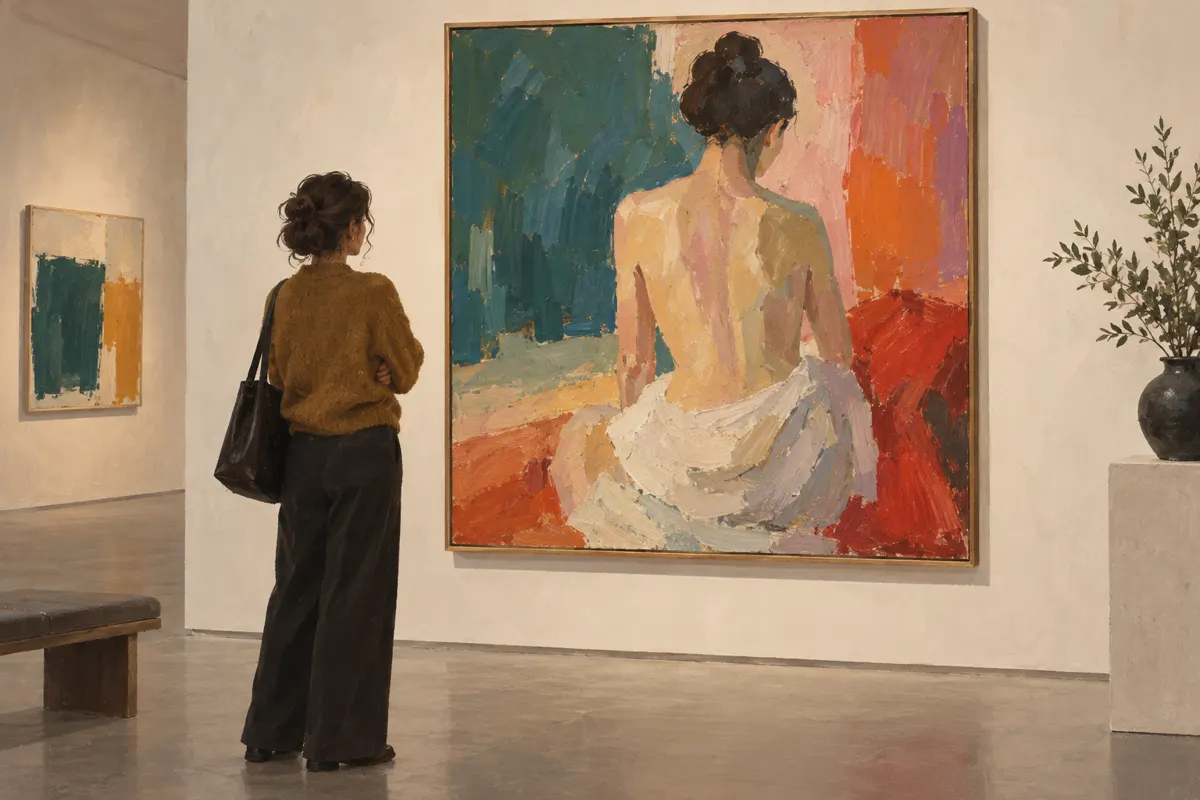
Start by looking at the painting itself: notice its subject, colors, arrangement, and small details before reading the gallery label. You do not need to recognize the artist or know art history to describe what you see. The sequence below is a suggested looking exercise: use it to build an interpretation from visible clues, while leaving room for questions.
Start with what you can see
Choose one painting that catches your attention and stand where you can see the whole work comfortably. Begin with a plain description, as though you were explaining the image to someone who cannot see it. Save judgments such as beautiful, strange, or badly painted for later.
- Identify visible people, objects, places, or shapes.
- Notice any action: someone turning away, a boat approaching, or a hand reaching.
- Separate what is clear from what is uncertain. A dark shape might be a doorway, but you can leave that identification open.
If the painting is abstract, there is no need to find a hidden object. Describe what is present: a broad yellow area, overlapping curves, or a narrow black line. A sentence such as “Several pale shapes float against a dark background” gives you a useful starting point.
Notice color and light
Next, look for the colors that occupy the most space and those that stand out. You do not need specialized names. Blue-gray, pale green, and bright orange are precise enough. Compare the lightest and darkest areas, then notice where their edges meet.
- Which color do you notice first, and where does it appear again?
- Are the colors mostly muted, vivid, or a mixture?
- Where is the brightest area? Does it suggest a source of light?
- What feeling do these choices give you, and which visible feature supports that response?
Treat your emotional response as a starting point for inquiry. Instead of deciding that blue means sadness, try: “The cool colors and dim light make this scene feel quiet to me.” That connects your reaction to the painting without assuming everyone will respond the same way.
Follow the arrangement across the painting
Composition means the arrangement of elements within the picture. Look at where your attention lands, then follow where it goes next. A face, a bright patch, or a strong diagonal might catch your eye. Ask what draws you there: size, position, contrast, or detail.
- Locate the main shapes and compare their sizes.
- Trace visible lines, such as a road, table edge, branch, or repeated curve.
- Look at the spaces between objects and around the edges.
- Notice whether the arrangement feels balanced, crowded, open, or tilted.
For example, a small figure surrounded by empty space might seem isolated to you. Check that impression against other clues: the figure’s posture, nearby objects, and the direction they face. One feature can suggest an interpretation; several related features give you more to discuss.
Examine a detail, then return to the whole
Move closer if the gallery allows, keeping behind barriers and avoiding contact with the work. Pick one detail: a sleeve, a reflection, a patch of sky, or the boundary between two colors. Notice whether the paint looks smooth, thick, broken, or loosely brushed.
Compare that area with another. Is a face carefully defined while the background is blurred? Does a shape that looked solid from farther away resolve into separate strokes? Step back again and see how the detail contributes to the larger image.
You can also choose a detail you initially overlooked. Ask whether it changes your first description. A second figure, an unexpected shadow, or a repeated color may give you a new question without settling the painting’s meaning.
Read the label and look again
Now read whatever information the gallery provides. Look for the title, artist, date, materials, and any explanatory text. Compare those details with your observations. Does the title identify something you missed? Does the explanation introduce a context you could not infer from the image?
Return to the painting and check the connection. You can revise an interpretation while keeping your original observations. Finish with three short statements: “I noticed…,” “I think… because…,” and “I still wonder….” You might notice a turned face, interpret it as withdrawal because of the posture, and still wonder whom the person is avoiding. That is a useful encounter with a painting, even without a final answer.