How to plan a backyard scavenger hunt for adults
· Editorial team newswithtomseattle.com
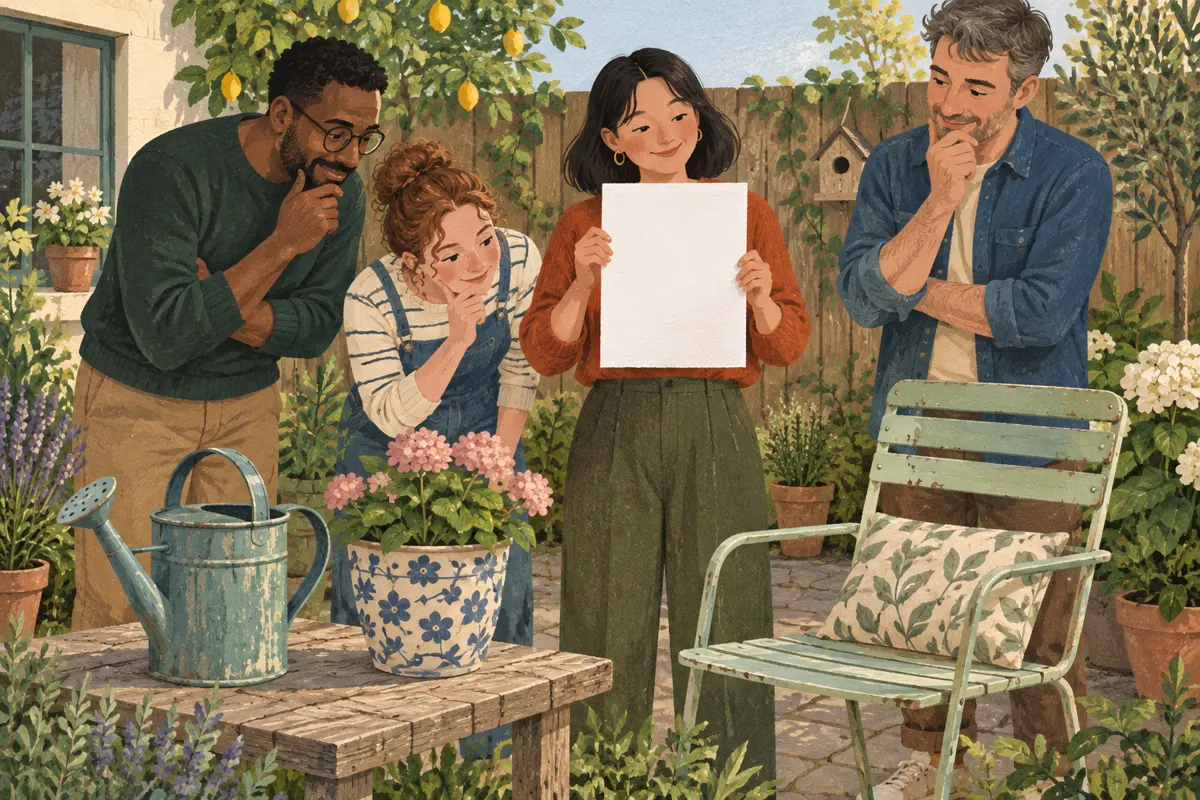
Plan a backyard scavenger hunt for adults by choosing a clear play area, writing clues about objects already there, and deciding how teams will record their answers. Add interest with observation puzzles and shared decisions. The proposed format below uses paper, pens, and ordinary outdoor objects, with optional phone photos.
Choose the format and mark the boundaries
For a straightforward first game, give every team the same list of challenges and let them complete it in any order. A linked trail, where each answer reveals the next location, takes more preparation and can create a queue when several teams reach one clue together.
Suggested starting format: pairs or small teams, eight challenges, and a 25-minute limit. Adjust those choices to your guests and yard. Choose a central table as the starting point, answer station, and finish.
- Name the areas included, such as the patio, lawn, and path beside the beds.
- Exclude sheds, neighboring property, pools, and any uneven or slippery areas.
- Require walking, with no climbing, digging, opening containers, or moving heavy objects.
- Keep plants and outdoor objects in place; record answers instead of collecting them.
Build clues around what is already outside
Walk through the play area and list visible features: a watering can, fence latch, patterned pot, chair, stepping stone, or coiled hose. Choose objects guests can identify from an accessible spot. Avoid clues that depend on a visiting bird, an opening flower, or a shadow staying in one position.
Make each challenge ask for a detail, comparison, or deduction. A clue becomes more interesting when players must inspect an object rather than simply name it. These proposed examples need adapting to the objects in your yard:
- Find the object that carries water without a hose. Record its color and the shape of its handle.
- Locate the pot with a repeating pattern. Sketch one repeated shape.
- Find two outdoor objects made from different materials. Name each object and its material.
- Count the slats in the designated chair back. Use that number as your answer.
- Photograph a pair of objects with the same shape but different purposes.
Mix easy finds with a few puzzles. For a final challenge, assign letters to selected correct answers and ask teams to rearrange them into a word. Check that the intended answer is possible and that no similar object creates an accidental alternative.
Set up answers, scoring, and hints
Prepare one answer sheet per team and a separate answer key for the host. Written answers work without phones. For photo challenges, one phone per team is enough; offer a sketch or written description when someone prefers that option.
- Award one point for each completed challenge that meets the stated requirements.
- Give every team up to two hints without a penalty.
- Accept equivalent answers when a clue allows more than one valid interpretation.
- Resolve a tie with one bonus observation question, or share the win.
For a cooperative version, have everyone complete one sheet together. Invite teammates to rotate reading, recording, and checking answers so one person does not handle every task.
Adapt the hunt for a small backyard
A compact yard can support several challenges at the same location. A patio table might supply a texture clue, a shape comparison, and a counting puzzle. Give teams different question orders to spread them around the space.
Another proposed variation is a close-up photo hunt: take cropped pictures of details on fixed objects, then ask players to identify the objects. Keep enough detail visible to make each image solvable. Place all clues within comfortable reach or clear view, and allow seated participation where practical.
Check the clues and run the game
- Walk the play area with the finished sheet. Confirm every answer, remove ambiguous clues, and check access.
- Prepare a weather alternative, such as moving suitable objects and rewritten clues into an indoor room.
- Welcome players at the starting table. Explain boundaries, answer requirements, hints, and the finish time.
- Hand out sheets and pens. Stay available to clarify wording and keep track of time.
- Review answers together at the finish, explain the puzzles, and collect any clue cards you placed outside.
Keep the ending relaxed. Sharing a surprising detail or a clever interpretation gives everyone something to discuss, whether you award a winner or play as one group.